Greetings from Reykjavik!

This is Thanda, I am also a rising junior at Wellesley College and an Environmental Studies major. I couldn’t be more excited to be a part of the Biological Carbon Pump Team this year. I’m looking forward to expanding on my studies of oceanography though this research experience and learn about working on a research vessel.
Me with a very Icelandic cow statue

We will soon be setting off on our research cruise and after months of anticipation and preparation I am finally embarking on my first research experience! The boxes that Claire, Hilary and I had packed at Wellesley back in June are now unpacked and now we have a fully functioning lab space. This involved tying down every single item to a bolted surface in a tangle of bungee cords, zip ties, twine, and ratchet straps to ensure that instruments do not go flying across the room while at sea. I have come to find out that tying down things is truly an art form. In our lab space we’ve set up have the water filtration systems for chlorophyll and particulate organic carbon, a SUNA Nitrate Sensor, a Aanderaa Oxygen Optode for dissolved oxygen, a prototype dissolved gas sensor from Dr. Anna Michel’s lab at WHOI that measures pCO2, total dissolved gas pressure, and pO2, and a Winkler titration system.  Over the course of this cruise we will be collecting samples that will be sent back ashore to be measured in order to calibrate the sensors on all the equipment that OOI puts out throughout the year. The only water sample we will be measuring on the ship rather than preserving it to measure in the lab ashore will be our dissolved oxygen measurements because you cannot preserve oxygen to be measured at a later date.
A view of our lab with Claire (front), Shawnee (center), and Hilary (back) hard at work
 In between unpacking and getting the lab set up Claire, Shawnee and I have taken some time to explore the R/V Neil Armstrong as it is our first time on the ship. It feels big now, but I know the longer that we are on board, the smaller it will become. There a lot of nice look out points on the ship where we could see the city from our spot in the harbor, and we also found spots where it will be nice to watch the work that OOI is doing over the course of the cruise.


A view from the bow of the ship where you can see the Harpa music hall and the Hallgrimskirkja Church in the backgound, iconic destinations in Reykjavik
Our time in Iceland maybe coming to a close, but our research is only just beginning! Check back for more updates from the Irminger Sea!

Heading out to Sea


Hello, and welcome to our blog! I am Claire, a student working on Hilary’s team. I am a rising junior and am an Environmental Studies and political science double major. I wanted to give a little bit of background on the scientific research we will be doing on our cruise.
We are going to be researching the biological pump. At a basic level, the biological pump moves carbon to the deep ocean through biology (like plankton or phytoplankton). Phytoplankton use sunlight and nutrients in the water to change dissolved Carbon Dioxide (or CO2) into organic carbon. I find this really interesting because I am curious about the effects of the biological pump on climate change. This research could help us understand how our oceans were going to react to increasing levels of CO2 in our atmosphere. The oceans already take up 24% of anthropogenic emissions, and the biological pump gives us a clearer picture of how our oceans are going to react to the climate crisis.
Here is a diagram of the Biological Carbon Pump. Note that POC stands for particulate organic carbon and that the euphotic zone is the area of the ocean where there is light. Photo © Microbial control of the dark end of the biological pump by Thomas Reinthaler & Gerhard Herndl
We can better understand how the oceans might absorb anthropogenic emissions by looking at how carbon moves through the water column. Like I mentioned earlier, in the light areas of the ocean, phytoplankton use dissolved CO2, water, and solar energy phytoplankton create organic carbon and oxygen through the process of photosynthesis. Zooplankton then eat the phytoplankton and respire (the opposite of photosynthesis where the zooplankton eat organic carbon and create CO2). A fraction of this carbon then sinks from the surface and collects in deeper levels of the ocean (or is sequestered). Below layers of the ocean with light, zooplankton and bacteria eat the sinking carbon, and in turn respire. The biological pump transports carbon to the deep ocean as it moves from the atmosphere, into the water, where it is used for photosynthesis and becomes organic carbon that moves down the water column.
Here are all three of the gliders we will be deploying on our cruise. They are autonomous robotic vehicles that will measure things like temperature, salinity, and  the ones modified for our research (525 and 560) will even measure oxygen in the air as well as the water, giving us even better calibration than the standard version!

This means that the biological pump has the ability to sequester carbon in the deep ocean. We are looking at this the biological pump in the Irminger Sea because it is the site of one of the largest phytoplankton blooms in the ocean. In understanding how this carbon moves down through the water column we can better understand how the ocean works, but also its potential affects on things like climate, and climate change.
We are going to leave the port in the morning, and head out on our cruise! I am so excited and hopefully you all will enjoy hearing about our trip.
A picture of me in the beautiful city of Reykjavik


Down to the seas again

(by Hilary)

It's now been over a year since we returned from our cruise last summer, and it's now time for a repeat trip out to the Ocean Observatories Initiative's Irminger Sea array to continue our research investigating the biological carbon pump and its role in ocean carbon cycling in the subpolar North Atlantic. The OOI team makes this trip every year to recover the instrumentation deployed the previous summer and deploy a new set of instrumentation to collect data over the coming year, and our research group will be joining the cruise now for a second time.

Over the past year, the instrumentation we deployed last June has weathered intense storms and even a visit from some springtime bergy bits, collecting data all the while about the oceanographic conditions in the region.
View of a bergy bit floating past the OOI array surface mooring on April 2. This photo was captured by the camera mounted on the mooring instrument frame, visible in the foreground.
We've spent much of the past year analyzing data being sent back in real time by the gliders, autonomous underwater vehicles, we deployed last June. All of the moorings deployed last year are still out at sea waiting for our cruise to pick them up, but our project glider was recovered early last month, after a successful mission improving the calibration of the oxygen sensors at the array and over a full year spent at sea.

The OOI glider outfitted to collect oxygen measurements in air as well as seawater suspended in midair off the side of the ship while being recovered in June.

Our research team has also experienced lots of exciting changes in the past year. Our stalwart bloggers from last year, Lucy Wanzer and Emma Jackman, have both graduated from Wellesley and are off on their next adventures - Emma applying her lab skills and safety training in a job managing hazardous waste in the Boston area, and Lucy setting off for a Thomas J. Watson Fellowship where she will learn about small boats in island communities around the world.
Emma (left), Hilary (center), and Lucy (right) in front of the research posters that Emma and Lucy presented last summer. 
I will be the one returning face from our project's seagoing team last year, though with changes for me as well as I have just moved from Wellesley to a new job as an assistant professor at Boston College. New joining the team this year are Thanda Newkirk and Claire Hayhow, both rising juniors majoring in Environmental Studies at Wellesley, and Shawnee Traylor, a first year PhD student in Roo Nicholson's lab in the WHOI-MIT joint program. Thanda, Claire, and Shawnee will be collecting data on our cruise to help us better understand marine biogeochemistry in the North Atlantic and calibrate the many sensors that the Ocean Observatories Initiative deploys in the Irminger Sea. They will also be leading this year's blogging effort, so follow along to hear all about our research and their experience conducting science at sea!

Winding down!

(by Emma)

Now that all of our CTD casts have been completed, our team has started working on other tasks, and we’ve made time in our schedule for daily Science Meetings. Hilary has invited other researchers on the ship to discuss some of their scientific research with us during these meetings. This gives us a chance to learn more about them and their experiences in depth.


On Wednesday, we learned about Chief Scientist Alison Macdonald’s research on transport of water through the Pacific Ocean using chemical signatures. Alison is a physical oceanographer, which means that she focuses on understanding the physical movement of water within the ocean. On one of her research projects, she gathered data on various cruises crossing the Pacific using CTD casts to determine at what depths a certain chemical signature was found, and how far across the Pacific the currents carried the signature. Knowing that several specific types of water, called mode waters, are formed on the western Pacific, Alison could model the paths and depths of mixing that the water experienced as it moved eastward, towards North America. 

Photo of 4 smiling women standing on the deck of a research vessel. All are dressed warmly, and the second woman from the left is holding a glass bottle. To the right of the picture the open ocean is visible, and in the far background is a surface mooring which looks very small.
Emma (myself), Lucy, Heather Furey, and Alison Macdonald on the CTD deck of the R/V Neil Armstrong. This photo was taken during our last sampling for the cruise, and the goal of this CTD cast was to further calibrate the sensors on the gliders which OOI deployed the week before. In the far right background, the surface mooring buoy which OOI deployed the first week is visible. It looks very small on the open ocean! Photo by Hilary Palevsky.

Besides telling us about the projects she has worked on, Alison also told us about her experience working on research cruises all over the world. She recently came back from a cruise on the Southern Ocean, where she was also serving as Chief Scientist. On many of the cruises Alison has worked on, students are given the opportunity to operate the CTD for round-the-clock casts. This cruise is a bit of an exception, as almost all of the casts have been in the afternoon or early evening hours. Alison also suggested that Lucy and I learn to operate the CTD, which was very exciting!

Operating the CTD from the main lab involves keeping track of the sensors and communicating with the winch as the CTD descends and returns. Dave Wellwood, a WHOI scientist on board to calibrate the OOI moorings, taught Lucy and I the basics of CTD operation. Lucy and I learned to how to determine the sea floor depth and how to politely ask the winch operators to move the CTD to target depths. Watching the computer monitors for continuous data from the sensors, we manually recorded the water temperature and salinity at each target depth. At the end of the cast, we save the data to the server and head out to the deck to sample, or watch others sampling. I felt quite powerful pressing buttons and firing bottles for the CTD, although Lucy was the one in charge of winch communications.

Photo of a smiling young woman sitting and holding a walkie-talkie, facing a man sitting in a chair and holding a clipboard. Behind both the people is an array of computer screens mounted on the wall, showing maps and lines of text listing information.
This is Lucy and Dave Wellwood calling the CTD back up to target depths for an OOI cast. Lucy communicated with the winch via walkie-talkie. 
Photo of a young woman facing away from the camera, looking at a computer screen showing a series of graphs. A man is sitting beside her, also facing the computer screen, and holding a walkie-talkie.
This is Dave and I during another CTD cast, watching the graphs showing the sensors’ data as the CTD ascends. Photo by Hilary Palevsky.

Lucy and I also took a trip up to the bridge of the Armstrong, where we had a great view of the ocean. Quinton Edwards (Chief Mate) and Keenan Foley (Able-bodied Seaman), showed us the navigation system and control board. The Armstrong has a dynamic positioning system which can keep the ship in a certain position automatically, which is important for tasks such as mooring deployments. On the bridge, Keenan also told us about his other trips on the Armstrong, and his experiences navigating near Greenland, where icebergs are a greater threat. As one of the seamen on board, he stands watch on the bridge for two shifts a day and completes other necessary work on the ship.

Photo of a smiling young woman standing on the bridge of a ship with her right hand resting on a large, horizontal control panel. Her hand is by a steering wheel about 6 inches in diameter. In the background are windows looking out onto the ocean.
This is Lucy standing at the controls of the Armstrong. There are several screens showing the bathymetry of the surroundings, maps of the Irminger Sea, and other important information relevant to navigating the ship. The bridge had a wonderful view of the ocean from all directions, but because it is at the top of the ship, it experiences the most rocking. 

We are already steaming back to Reykjavik, and will reach port on Sunday!

Cheers,
Emma

Cups!


It’s a tradition aboard oceanographic research vessels to send styrofoam down to the depths of the ocean (and then bring them back up, of course!). On Tuesday, after many days of decorating, we sent a bag of Styrofoam cups down to 2,500 meters. For some of us, this was a first in decorating cups and sending them down to the bottom of the ocean. For others who have been aboard tens of cruises, it was not very exciting to make another cup. The majority of the cruise members partook in the artistic activity of decorating a cup, and the designs ranged from chubby birds to gliders to pride flags. Some common designs were the surface mooring, the CTD, the OOI logo, and the Neil Armstrong. A few ramen cups were also sent down. Along with the design, it is customary to write the latitude, longitude, and depth on the cup.
 
Smiling woman holds two cups with drawings on them. She holds the cups up just below her head.
Me holding 2 of my 6 cups. On the left cup is a Northern Fulmar, the seabird that is very common out here! On the right, I drew the surface mooring, and the glider. 
After decorating the cups, we put them in a mesh laundry bag, and attached them to the CTD. We heard some horror stories about the cup bag breaking, so we secured it well with zip ties and electrical tape. The CTD went down to 2,500 meters and its return was much anticipated. 
Two women hold a bag full of styfofoam cups. Behind them is the CTD, a gray, oceanographic instrument that has many bottles, each of which close at different depths in the ocean. Behind the instrument is the ocean.
Emma and I holding the bag of cups before attaching it to the CTD. 
A gray instrument with bottles is lifted onto the deck of the boat by a crane. Attached to the instrument is a bag full of styrofoam bottles.
The CTD returning with our shrunken cups attached!

Upon return, Emma and I were shocked at how very tiny the cups became! The cups shrink when they go down to 2,500 meters because the huge amount of pressure at that depth (250 times the atmospheric pressure that we and the cups experience at the surface) forces the air out of the styrofoam. The interesting part is that we started with two different kinds of cups: ones that were originally very small, and large Styrofoam cups. Once they returned, we noticed that the large cups had shrunk more than the small ones! Henry informed us that the amount of shrinking depends a lot on the brand of Styrofoam.
 
Three people attend to the bag of bottles attached to the gray instrument. One of them cuts the bag off the CTD, while the other two watch.
Emma, Henry and I cutting tape and zip ties to remove the cup bag from the CTD. 
A few of the cups had shrunk into each other, so to separate them apart, we soaked them in hot water, and patiently pried them apart. Many of the cups deform and shrink in funny ways, so we also used the hot water to reshape a few.

On the left, many shruken styrofoam cups sit on top of one another. On the right, the original full size cup sits to show the scale of difference.
On the left are the shrunken cups and on the right is a cup that depicts the original size of the cups. 

The majority of the shrunken cups sit stacked on one another, with a computer in the background.
A collection of some of the cups after they have shrunken. 
It was a lot of fun!

Lucy 

Meet the Cast(s)!

(by Emma)

With four official CTD casts now under our belt, the Biological Carbon Pump Team (BCP Team) is feeling much more confident in our sampling and sample processing abilities. We have worked on establishing a system for pre-cast preparations, sampling procedures while the CTD is on deck, and post-cast sample processing. Before each cast, we gather and label the necessary bottles for each depth that we want to sample. 

Sensors on the CTD show us a profile of factors like dissolved oxygen, salinity, and temperature as it descends. We pay special attention to changes in the concentration of dissolved oxygen along the profile, because this variable is particularly important for our research. Changes in dissolved oxygen may indicate whether the water at these depths was previously in contact with the atmosphere. Air exchange at the ocean surface and mixing of surface water with deeper water contribute to the formation of a mixed layer visible in the profiles provided by the CTD. We try to identify the present boundary of this mixed layer as the CTD descends, and sometimes we can infer depths that the mixed layer reached in past seasons. We then take samples from these depths as part of the CTD cast.

Photo of a woman wearing a warm hat and red jacket, kneeling beside a 6-7 foot tall CTD on the deck of a ship. She is facing away from the camera but can be seen holding a small glass bottle with a syringe stuck into the top. In the background, partially hidden by the CTD, is a young woman mid-laugh, holding a differently shaped glass bottle with a stopper.
Hilary (red jacket) and Lucy (green sweater) are collecting samples from a CTD cast. Hilary has been working on her technique for preparing dissolved gases samples; the samples require a syringe to be inserted into the top of the bottle after stoppering. Lucy has been the official dissolved oxygen sampler for CTD casts, and can sample over 40 bottles per cast!

Dissolved oxygen concentrations also change over the seasons due to biology. Phytoplankton are small, floating organisms which produce oxygen as they photosynthesize. During the warmer and sunnier months, phytoplankton in the Irminger Sea undergo a spring blooming period. This increases the dissolved oxygen saturation in the upper depths of the ocean. We are arriving at the tail end of this spring bloom, so our measurements will hopefully reflect interesting patterns telling us about the productivity of these phytoplankton and the changing dissolved oxygen saturation as they die off and/or are eaten by larger marine organisms. 


We are also able to study dissolved oxygen levels using gliders, pictured below, which are autonomous underwater vehicles that look like mini yellow submarines. On Sunday, the OOI team released two gliders to swim between the stationary moorings of the Irminger Sea array. As part of Hilary’s NSF-funded project, the oxygen sensors on both gliders were moved from the underside of the glider to the top. This allows them to periodically check the oxygen concentrations in the air to compare with measurements of dissolved oxygen in the ocean. The goal of these modifications is to better calibrate the oxygen sensors not only on the gliders but also the stationary oxygen sensors in the Irminger Sea array, because each glider will be swimming between each of the moorings over the course of the year. Watching the deployment of the gliders was very exciting!

Photo of a yellow glider, about 6 feet long, strapped to a row of desks inside a lab. The view is lengthwise, with the front of the glider pointed away from the viewer. The end closest to the viewer has a yellow fin standing upright, and a black oxygen sensor about 3 inches long mounted beside it with a piece of blue masking tape attached. Visible on the body of the glider is a dark blue NSF logo.
These are the gliders pre-deployment. The oxygen sensor is the small black piece with blue masking tape mounted by the fin at the end. Neither glider has its wings installed in the photo.

Collin Dobson, the glider pilot on board to oversee the glider deployment, told us more about how gliders navigate and function. Each glider is equipped with a fin and wings which direct its flight through the water. A pitch battery inside the glider slides about an inch forward and backward, guiding the angle of the dive. Each time that the glider surfaces, it communicates data back to WHOI and checks its GPS position to determine how it will navigate to its next point. I think it’s amazing that while underwater, the glider relies completely on its past GPS point to get to the next position, as it cannot determine its exact position underwater.

Photo of a smiling, bearded man kneeling beside a yellow glider, with his right hand holding the glider fin. He is wearing a black jacket and jeans, and visible in the background are hanging life jackets and laboratory equipment.
This is Collin with the two gliders that we later deployed to swim around the Irminger Sea. He is a glider pilot with WHOI who enjoys giving unofficial names to his deployed gliders. 


It's hard to believe that we are almost halfway through the research cruise!
Cheers,
Emma

A Day in the Life Aboard the Armstrong


We have now been aboard the ship for well over a week, and are settling into our routines. Thanks to a few reader requests, this post will be about a day in the life aboard the Armstrong!

Life aboard a research vessel is quite different than life on shore. For instance, most people aboard the ship do not sleep regular hours. For the crew members especially, someone needs to be awake at all times to do things like navigate the ship, make sure that everything is running smoothly and keep us safe. In the case of our group, since we are a team of three, Emma and I have separate watch schedules. Her watch is midnight-noon, and mine is noon-midnight. Neither of us are usually awake for those full 12 hours, but it means that Emma is responsible for the 6:30 am sampling, and I am responsible for the 6:30pm sampling. Additionally, she is responsible for morning tasks, like sample processing, and I am responsible for afternoon tasks.  

The day starts with breakfast from 7:15-8:15. The food on the ship has been excellent, and there are always fresh berries at breakfast which has been a highlight for me. After breakfast, we finish processing samples from the day before, if there are any. We also make sure to check the plan for the day which the chief scientist writes and posts, daily. After looking these over, Emma and I talk with Hilary about our plan for the day. If we are not processing samples in the morning, we work on things like blog posts, data entry, and cleaning lab materials.
 
A photo of five women sitting, eating a meal. There is a porthole in the background. One woman is talking while the four others listen.
Amy Bower, me, Alison Macdonald, Heather Furey, and Emma (from left to right) eating lunch in the mess hall. Photo by Hilary Palevsky.   
Lunch happens from 11:15-12:15. During this meal, we often chat with folks from other teams about their projects and what they have planned for the day. After lunch, I take underway water samples. The Armstrong continuously pumps sea water from the surface through the boat. Three times a day: 6:30 am (Emma), 12:30 pm (me), and 6:30pm (me), we collect oxygen, chlorophyll, and nutrient samples from the surface sea water. After collecting the samples, the chlorophyll must be immediately filtered. The water is pumped across a filter, and after all the water has gone through, the filter is folded up for later analysis. Usually the filter is tinted green, indicating we have collected lots of phytoplankton!

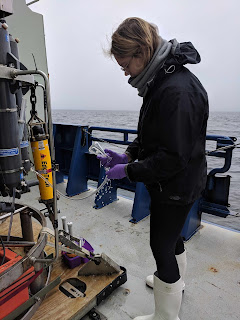
After lunch, we are often preparing for a CTD cast happening in the late afternoon. Over the past 4 days, CTD casts have become an important part of our day. A CTD is an instrument that measures salinity, temperature, and depth. Attached to this instrument is a set of bottles, each of which captures water at a particular depth. When we perform a CTD, we send the CTD instrument, along with the bottles, down to a particular depth. So far we have sent the CTD all the way to 2,600 meters! Then, on the way up, the bottles close and capture water from the depths we request. To prepare for the cast, we label all our collection bottles, and gather all the supplies we need to take samples. We also gear up in waterproof clothing and boots, so that we don’t get our clothing wet from the sea water. Sometimes waves will come over the side of the boat while sampling if the seas are high enough, and in this case we are particularly happy to have waterproof gear.

 
Photo of a large oceanographic instrument and a woman inspecting the tubing attached to the instrument. The instrument is a bit taller than a human and contains 24 gray bottles. The woman has a tube attached to a bottle.
Me with the CTD. I am sampling oxygen, and before sampling I check the tubing to make sure there are no bubbles. Photo by Hilary Palevsky.  
A photo of a woman holding a tube upside down while water flows out of the tube and into a bottle. She is standing next to part of the instrument described in the previous photo. The ocean is in the background.
After checking there aren't any bubbles in the tubing, I rinse the bottle many times before filling it with water. Photo by Hilary Palevsky.   

Along with our team, two other scientists also collect water on the CTD casts. We spend time coordinating with them about the sampling procedure before each cast. The amount of time it takes to sample from the CTD depends on how many samples we are collecting. Recently, sampling has taken between 1 and 2 hours after the CTD comes out of the water. During or after sampling, we eat dinner. After sampling from the CTD, I stay up and process the chlorophyll samples, as these need to be filtered as soon after collection as possible. If it gets too late, I will save some sample processing for Emma in the morning!

In our free time, Emma, Henry (our lab mate), and I often do crosswords. So far we have completed 5 crosswords and we are definitely improving. Other folks play cards in the mess hall, and I’ve been reading as well. Internet is limited aboard the ship, so we don’t spend much time online. We also spend time watching other groups deploy moorings and gliders. An important part of this cruise is learning about the cool instruments that other OOI groups have engineered. We’ve been lucky enough to get tours of moorings and gliders, and learn about the instruments on them and how they work.

Everyday aboard the ship is different, and because the sea is our work environment, plans change quickly depending on weather. Until next time… Lucy